
Edition Comparison
Edition Comparison
Overview
FastBee-Arduino provides three editions targeting different hardware platforms and use cases. Users can select the appropriate edition based on cost budget, feature requirements and hardware resources.
Edition selection ultimately affects the visible features in the Web console. Lite/Standard focus on dashboard, network, peripherals and peripheral exec; Full additionally provides file, log, user and role management capabilities.
Stability Assessment Conclusion
The current edition split is recalibrated by "chip resource first":
- Lite targets ESP32-C3/C6 single-core or low-memory chips, retaining only WiFi, MQTT, mDNS, Web management, basic sensors, OLED/TM1637 display, config import/export and health monitoring. Modbus, W5500, 4G, BLE, OTA, Command Script, RuleScript and other extra modules are disabled by default, avoiding heap memory pressure when serial/SPI peripherals, network stack and Web management run simultaneously.
- Standard targets ESP32/ESP32-S3 dual-core chips, retaining WiFi, MQTT, Modbus RTU master, Command Script, RuleScript, I2C sensors, RFID, IR and other common field capabilities; Ethernet, 4G, BLE, file/log management and multi-language are disabled by default.
esp32s3-F8R0is a Standard + OTA special case; 4MBesp32-F4R0keeps OTA disabled. - Full targets ESP32/ESP32-S3 modules with PSRAM, including
esp32-F8R4,esp32s3-F8R4,esp32s3-F16R8. This edition is for gateways/advanced controllers, enabling Ethernet, 4G, OTA, file/log, user roles, multi-language and other capabilities. BLE is disabled by default since 2026-08 as there is no complete BLE provisioning/communication link; do not promise BLE as an available feature at delivery.
The former TCP client/HTTP client/CoAP protocol modules were removed from the device firmware in 2026-08; cloud access is unified through MQTT.
*-unifiedfull-feature build environments with Web feature configuration provide on-demand trimming, see Build Configuration.
This split is more stable than "all editions enable 4G/Ethernet/Modbus": low-cost chips don't bear the long-term memory pressure of external network adapters, Modbus polling/routing, multi-language large resources, script engines and multiple protocol stacks; dual-core Standard covers common WiFi + MQTT + RS485/Modbus scenarios; Full is concentrated for gateways or advanced controllers with PSRAM.
Multi-language strategy recommendation by edition: Lite/Standard default to single-language resources, reducing LittleFS usage and frontend initialization burden; Full retains the complete multi-language experience. The current lite/prod Web profile still uses the i18n engine for Chinese text but does not provide language switching; if Lite/Standard firmware needs to completely remove the i18n mechanism, a separate static Chinese Web asset build tier is needed.
Edition Overview
| Dimension | Lite | Standard | Full |
|---|---|---|---|
| Positioning | Low-cost sensor node | Main IoT device | Flagship gateway/controller |
| Target Users | Batch deployment, cost-sensitive | General IoT development | Advanced feature requirements |
| Price Range | ¥9-12 | ¥12-20 | ¥15-25 |
| Build Environments | esp32c3-F4R0 / esp32c6-F4R0 | esp32-F4R0 / esp32s3-F8R0 | esp32-F8R4 / esp32s3-F8R4 / esp32s3-F16R8 |
| Max Peripherals | 16 (hard limit) | 24 (hard limit) | 32 (hard limit) |
| Recommended Rules | 12 (soft limit) | 24 (soft limit) | 32 (soft limit) |
| Sensor Cache Entries | 16 | 24 | 32 |
Chip Compatibility Matrix
Lite - Recommended Chips
| Chip | Architecture | Clock | RAM | Flash | BLE | WiFi | Recommendation |
|---|---|---|---|---|---|---|---|
| ESP32-C3 | RISC-V Single-core | 160MHz | 400KB | 4MB | 5.0 | 2.4GHz | ⭐⭐⭐⭐⭐ |
| ESP32-C6 | RISC-V Single-core | 160MHz | 512KB | 4-8MB | 5.3 | WiFi 6 | ⭐⭐⭐⭐⭐ |
Selection Guide:
- ESP32-C3: Lowest cost option, ¥9-12, retains core IoT features
- ESP32-C6: Future-proof, supports WiFi 6 and BLE 5.3, ¥12-15
Standard - Recommended Chips
| Chip | Architecture | Clock | RAM | Flash | BLE | WiFi | Recommendation |
|---|---|---|---|---|---|---|---|
| ESP32 | Xtensa Dual-core | 240MHz | 520KB | 4-16MB | 4.2 | 2.4GHz | ⭐⭐⭐⭐⭐ |
| ESP32-S3 | Xtensa Dual-core | 240MHz | 512KB | 8-16MB | 5.0 | 2.4GHz | ⭐⭐⭐⭐⭐ |
| ESP32-C6 | RISC-V Single-core | 160MHz | 512KB | 4-8MB | 5.3 | WiFi 6 | ⚙️ Custom |
Selection Guide:
- ESP32 (Classic): Most mature ecosystem, cheapest modules, suitable for general development
- ESP32-S3: Stronger performance, supports USB OTG and AI acceleration, suitable for high-performance scenarios
- ESP32-C6: Defaults to Lite; if Standard capabilities are needed, recommend custom build with item-by-item stress testing, not released as default stable edition
Full - Recommended Chips
| Chip | Architecture | Clock | RAM | Flash | PSRAM | Recommendation |
|---|---|---|---|---|---|---|
| ESP32-S3 | Xtensa Dual-core | 240MHz | 512KB | 8-16MB | 2-8MB | ⭐⭐⭐⭐⭐ |
| ESP32 + PSRAM | Xtensa Dual-core | 240MHz | 520KB | 4-16MB | 4MB | ⭐⭐⭐⭐ |
Selection Guide:
- ESP32-S3 (N16R8): First choice, 8MB PSRAM + 16MB Flash, performance and memory both sufficient
- ESP32 + PSRAM: Slightly lower cost, but USB capabilities not as good as S3
Detailed Feature Comparison
1. Network Communication
| Feature | Lite | Standard | Full | Description |
|---|---|---|---|---|
| WiFi STA Mode | ✅ | ✅ | ✅ | Connect to router for internet |
| WiFi AP Mode | ✅ | ✅ | ✅ | First-time setup hotspot |
| MQTT Communication | ✅ | ✅ | ✅ | Communicate with cloud platform |
| mDNS Discovery | ✅ | ✅ | ✅ | LAN device discovery; retained in Lite |
| Ethernet (W5500) | ❌ | ❌ | ✅ | Full enables by default; Standard disabled by default |
| 4G Cellular | ❌ | ❌ | ✅ | Full enables by default; Standard disabled by default |
| BLE Provisioning | ❌ | ❌ | ⚠️ Reserved | Full retains BLE switch, but no complete BLE provisioning page and handling chain |
2. Communication Protocols
| Feature | Lite | Standard | Full | Description |
|---|---|---|---|---|
| MQTT Protocol | ✅ | ✅ | ✅ | Main communication protocol |
| Modbus RTU Master | ❌ | ✅ | ✅ | RS485 device communication; Lite disabled by default |
| Modbus RTU Slave | ❌ | ❌ | ✅ | Respond as slave device |
TCP Passthrough / HTTP Client / CoAP modules were removed in 2026-08; cloud access is unified through MQTT.
3. Web Management Interface
| Feature | Lite | Standard | Full | Description |
|---|---|---|---|---|
| Web Server | ✅ | ✅ | ✅ | AsyncWebServer |
| Device Status Dashboard | ✅ | ✅ | ✅ | Homepage status display |
| Peripheral Config Page | ✅ | ✅ | ✅ | GPIO/Sensor configuration |
| Peripheral Exec Page | ✅ | ✅ | ✅ | Automation rule configuration |
| Network Config Page | ✅ | ✅ | ✅ | WiFi/MQTT settings |
| Protocol Config Page | ✅ | ✅ | ✅ | Communication protocol management |
| Device Config Page | ✅ | ✅ | ✅ | Device basic info |
| SSE Real-time Push | ✅ | ✅ | ✅ | Real-time status updates |
| Login Authentication | ✅ | ✅ | ✅ | Lite/Standard use single admin mode; Full supports user/role management |
| File Manager | ❌ | ❌ | ✅ | File browse/upload |
| Log Viewer | ❌ | ❌ | ✅ | Online system log viewer |
| Multi-language (i18n) | ❌ | ❌ | ✅ | Lite/Standard target single-language resources; Full retains full multi-language |
| Config Import/Export | ✅ | ✅ | ✅ | Device config migration |
| Service Worker | ✅ | ✅ | ✅ | Offline cache acceleration |
4. Peripherals & Sensors
| Feature | Lite | Standard | Full | Description |
|---|---|---|---|---|
| GPIO Control | ✅ | ✅ | ✅ | Digital input/output |
| DHT11/DHT22 Temp/Humidity | ✅ | ✅ | ✅ | Temperature and humidity sensor |
| DS18B20 Temperature | ✅ | ✅ | ✅ | One-wire thermometer |
| OLED Display | ✅ | ✅ | ✅ | U8g2 driver |
| TM1637 7-Segment | ✅ | ✅ | ✅ | Seven-segment display |
| Command Script | ❌ | ✅ | ✅ | Command script engine; Lite disabled by default |
| NeoPixel/WS2812B | ✅ | ✅ | ✅ | RMT LED strip driver; Lite retains basic strip capability |
| I2C Sensors (BMP280/MPU6050) | ❌ | ✅ | ✅ | Pressure/gyroscope sensors |
| RFID (MFRC522) | ❌ | ✅ | ✅ | Radio frequency identification module |
| IR Remote Control | ❌ | ✅ | ✅ | IR transmit/receive |
| Rule Script Engine | ❌ | ✅ | ✅ | MQTT/Modbus data format template conversion |
5. Peripheral Execution Engine (PeriphExec)
| Feature | Lite | Standard | Full | Description |
|---|---|---|---|---|
| Timer Trigger | ✅ | ✅ | ✅ | Periodic tasks |
| Button Trigger | ✅ | ✅ | ✅ | Physical button events |
| Condition Trigger | ✅ | ✅ | ✅ | Sensor threshold trigger |
| MQTT Trigger | ✅ | ✅ | ✅ | Remote command trigger |
| GPIO Action | ✅ | ✅ | ✅ | Output HIGH/LOW |
| Display Action | ✅ | ✅ | ✅ | OLED/TM1637 display |
| Delay Action | ✅ | ✅ | ✅ | Delayed execution |
| Modbus Action | ❌ | ✅ | ✅ | Read/write Modbus devices; Lite disabled by default |
| Worker Pool | ✅ | ✅ | ✅ | Async task pooling |
| Execution Sync (EXEC_SYNC) | ✅ | ✅ | ✅ | Rules sync reported in real-time |
6. System Features
| Feature | Lite | Standard | Full | Description |
|---|---|---|---|---|
| Health Monitoring | ✅ | ✅ | ✅ | Memory/CPU monitoring |
| Memory Gating (MEMGUARD) | ✅ | ✅ | ✅ | OOM prevention |
| Task Manager | ✅ | ✅ | ✅ | Background task scheduling |
| Serial Logging | ✅ | ✅ | ✅ | Debug output |
| File Logging | ❌ | ❌ | ✅ | Persistent logging |
| OTA Firmware Upgrade | ❌ | Partial | ✅ | esp32s3-F8R0 retains OTA partition; 4MB Standard disables OTA |
| OTA Filesystem Upgrade | ❌ | Partial | ✅ | esp32s3-F8R0 supports Web filesystem OTA; 4MB Standard disables |
| NTP Time Sync | ✅ | ✅ | ✅ | Network time retrieval |
| DNS Service | ✅ | ✅ | ✅ | AP mode DNS |
Hardware Resource Usage
Memory Usage (Typical Values)
| Metric | Lite | Standard | Full |
|---|---|---|---|
| Firmware Size | ~1.8-2.1MB | ~2.2-2.5MB | ~2.6-3.0MB |
| Post-boot Free Heap | ~90-130KB | ~110-160KB | ~160KB+ (PSRAM can hold large objects) |
| Stable Running Heap | ~70KB+ | ~90KB+ | ~120KB+ |
| Web Filesystem | ~200-230KB (single-language target) | ~220-250KB (single-language target) | ~350KB |
| TCP Connection Budget | 4 (C3) / 6 (C6) | 6 (ESP32) / 8 (S3 budget) | 6 (ESP32) / 8 (S3 budget) |
Flash Partition Recommendations
| Partition | Lite (4MB) | Standard (4MB) | Full (8MB) |
|---|---|---|---|
| Firmware (app) | ≥2MB | ≥3MB | ≥3MB |
| Filesystem | 1MB | 1MB | 1MB |
| OTA Partition | ❌ | ❌ | 3MB |
| NVS | 24KB | 24KB | 24KB |
| coredump | ❌ | ❌ | 64KB |
Peripheral and Rule Limits
Different editions have different configuration limits designed for chip memory resources.
Configuration Limits
| Dimension | Lite | Standard | Full | Limit Type |
|---|---|---|---|---|
| Max Peripheral Config | 16 | 24 | 32 | Hard (GPIO/memory limited) |
| Recommended Exec Rules | 12 | 24 | 32 | Soft (warning only when exceeded) |
| Sensor Cache Entries | 16 | 24 | 32 | Soft |
Hard Limit: System refuses to add new items when limit is reached, returns clear error.
Soft Limit: System logs warning when exceeding recommended count, but allows continued creation. Actual running limits are controlled by:
MAX_ACTIVE_TASKS = 12: Maximum number of simultaneously running rules- System memory gating (MEMGUARD): Auto-degrades on low memory
Selection Recommendations
- Lite (ESP32-C3/C6): Limited resources, suitable for small-scale sensor collection and simple automation. Recommended 8-12 peripherals, 6-10 rules, with margin for stable operation.
- Standard (ESP32/ESP32-S3): Dual-core + sufficient RAM, suitable for medium-scale projects. Can configure 15-20 peripherals, 10-20 rules, including Modbus polling, command script and rule script; Ethernet/4G disabled by default.
- Full (ESP32/ESP32-S3 + PSRAM): Most abundant resources, suitable for gateway/controller scenarios. Can run at full capacity with 32 peripherals, 32 rules, simultaneously running Modbus polling, script engine, multi-protocol stack, file/log and remote maintenance features.
Note: When memory is tight, the system automatically enters
degradedmode, Web API list pagination temporarily reduces to 5 items per page to ensure page accessibility. Peripheral config returns errors when hard limit is reached; exec rules exceeding recommended values log warnings but don't prevent creation.
Runtime Configuration Differences
| Parameter | Lite | Standard | Full |
|---|---|---|---|
CONFIG_ASYNC_TCP_MAX_CONNECTIONS | C3=4 / C6=6 | ESP32=6 / S3=14 | ESP32=6 / S3=14 |
CONFIG_ASYNC_TCP_QUEUE_SIZE | C3=4 / C6=8 | ESP32=8 / S3=24 | ESP32=8 / S3=24 |
ARDUINO_LOOP_STACK_SIZE | 12288 | 16384 | 16384 |
SCRIPT_TASK_STACK | ❌ | 8192 | 8192 |
SIMPLE_TASK_STACK | 4096 | 6144 | 6144 |
FASTBEE_JSON_DOC_SIZE | 8192 | 8192 | 8192 |
CORE_DEBUG_LEVEL | 1 | 1 | 1 |
Build Environment Mapping
platformio.ini Environment Configuration
| PlatformIO Env | Edition | Chip | Description |
|---|---|---|---|
esp32c3-F4R0 | Lite | ESP32-C3 | 4MB Flash, no PSRAM, low-cost node |
esp32c6-F4R0 | Lite | ESP32-C6 | 4MB Flash, no PSRAM, WiFi 6 low-cost node |
esp32-F4R0 | Standard | ESP32 | 4MB Flash, no PSRAM, default mass production |
esp32-F8R4 | Full | ESP32 | 8MB Flash, 4MB PSRAM, ESP32 full feature verification |
esp32s3-F8R0 | Standard + OTA | ESP32-S3 | 8MB Flash, no PSRAM, OTA partition retained |
esp32s3-F8R4 | Full | ESP32-S3 | 8MB Flash, 4MB PSRAM, S3 full feature verification |
esp32s3-F16R8 | Full | ESP32-S3 | 16MB Flash, 8MB PSRAM, recommended full production env |
Build Commands
# Lite
pio run -e esp32c3-F4R0        # ESP32-C3 Lite
pio run -e esp32c6-F4R0        # ESP32-C6 Lite

# Standard
pio run -e esp32-F4R0          # ESP32 Standard
pio run -e esp32s3-F8R0        # ESP32-S3 Standard + OTA

# Full
pio run -e esp32-F8R4          # ESP32 Full
pio run -e esp32s3-F8R4        # ESP32-S3 Full
pio run -e esp32s3-F16R8       # ESP32-S3 Full
Recommended Use Cases
Lite Use Cases
- 🏠 Smart Home Sensor Node - Temp/humidity collection + MQTT reporting
- 🏭 Lightweight Data Collection - Local sensors + MQTT reporting
- 🌱 Agricultural Greenhouse Monitoring - Environment monitoring + auto control
- 💡 Smart Lighting Control - GPIO + timer/automation
- 📊 Low-cost Batch Deployment - Many nodes, cost-sensitive
Standard Use Cases
- 🖥️ General IoT Development Platform - Web config + standard field features
- 🔧 Device Debugging & Development - Rich Web management interface
- 🏗️ Smart Building Control - Multi-sensor + automation control
- 🏭 Industrial Data Collection - Modbus RTU + MQTT reporting
- 📡 Edge Gateway (Lightweight) - Data collection + forwarding
- 🎓 Education & Prototyping - Full-featured, easy to learn
Full Use Cases
- 🌐 Edge Computing Gateway - Multi-protocol support + high performance
- 🏭 Industrial Control Center - Modbus + Ethernet/4G
- 🔐 High-security Projects - Security auth + OTA
- 🛠 Field Maintenance Device - Files, logs, OTA, user roles
- 🚀 Feature Verification & Integration Testing - Complete device-side feature verification except BLE provisioning
Edition Selection Decision Tree
Start Selection
  ├── Cost sensitive? (unit price < ¥12)
  │   ├── Yes → Lite (ESP32-C3/C6)
  │   └── No ↓
  ├── Need any of these flagship features?
  │   • OTA remote upgrade
  │   • Files/logs/user roles
  │   • Multi-language management
  │   • 4G / Ethernet
  │   ├── Need 1+ above → Full (ESP32/ESP32-S3 + PSRAM)
  │   └── No ↓
  ├── Need any of these standard field features?
  │   • Modbus RTU
  │   • Command Script / RuleScript
  │   • I2C advanced sensors / RFID / IR
  │   ├── Yes → Standard (ESP32/ESP32-S3)
  │   └── No ↓
  └── Standard (ESP32/ESP32-S3)
Upgrade Path
Lite (ESP32-C3/C6)  →  Standard (ESP32/S3)  →  Full (ESP32/S3 + PSRAM)
     │                      │                      │
     │ Fully compatible     │ Fully compatible     │
     │ Only swap chip       │ Only swap chip       │
     │ Configs universal    │ Configs universal    │
     └──────────────────────┴──────────────────────┘
All three editions share the same codebase, controlled by compile-time feature switches:
- Upward compatible: Lower edition config files can be used directly on higher editions
- Downward compatible: Higher edition config fields for advanced features are ignored on lower editions
- Seamless migration: Change chip + modify build target to upgrade
Notes
ESP32-C6 Special Note
ESP32-C6 requires the pioarduino community platform:
[env:esp32c6-F4R0]
platform = https://github.com/pioarduino/platform-espressif32/releases/download/55.03.38/platform-espressif32.zip
Reason: The official espressif32 platform does not yet fully support ESP32-C6's Arduino framework.
ESP32-C3/C6 and PSRAM
ESP32-C3 and ESP32-C6 hardware does not support external PSRAM (lacks dedicated pins and SPI controller), therefore:
- All memory management for Lite must be done within on-chip SRAM
- Cannot extend memory via PSRAM
- JSON document size should not exceed 8KB
ESP8266 Not Supported
This project does not support ESP8266 chips, because:
- ESP8266 available heap is only ~40KB, unable to parse large config files (periph_exec.json ~33KB)
- Does not support BLE, dual-core, LittleFS and other core dependencies
- Severe heap fragmentation, unstable for long-term operation
- ESP32-C3 is only ¥3-4 more expensive with 10x performance improvement, making it a better low-cost choice
Deployment & Verification
This section covers firmware building, flashing, smoke testing, long-term stability verification and release artifacts, ensuring the selected edition can be successfully deployed. Core principle: PlatformIO environment, LittleFS Web filesystem, release images and target hardware must match.
One-Click Flash
cd D:\project\gitee\FastBee-Arduino
powershell -ExecutionPolicy Bypass -File scripts\doctor.ps1 -Port COM6
powershell -ExecutionPolicy Bypass -File scripts\deploy.ps1 -Env esp32-F4R0 -Port COM6
Common examples:
# ESP32 Standard, 4MB Flash
powershell -ExecutionPolicy Bypass -File scripts\deploy.ps1 -Env esp32-F4R0 -Port COM6

# ESP32-S3 Standard, 8MB Flash, OTA support
powershell -ExecutionPolicy Bypass -File scripts\deploy.ps1 -Env esp32s3-F8R0 -Port COM6

# ESP32-S3 Full, 16MB Flash + 8MB PSRAM
powershell -ExecutionPolicy Bypass -File scripts\deploy.ps1 -Env esp32s3-F16R8 -Port COM6

# Build only, no flash
powershell -ExecutionPolicy Bypass -File scripts\deploy.ps1 -Env esp32s3-F16R8 -BuildOnly
deploy.ps1 uploads the LittleFS Web filesystem for the current environment first, then flashes firmware. To update only part:
powershell -ExecutionPolicy Bypass -File scripts\deploy.ps1 -Env esp32s3-F16R8 -Port COM6 -SkipFirmware
powershell -ExecutionPolicy Bypass -File scripts\deploy.ps1 -Env esp32s3-F16R8 -Port COM6 -SkipFs
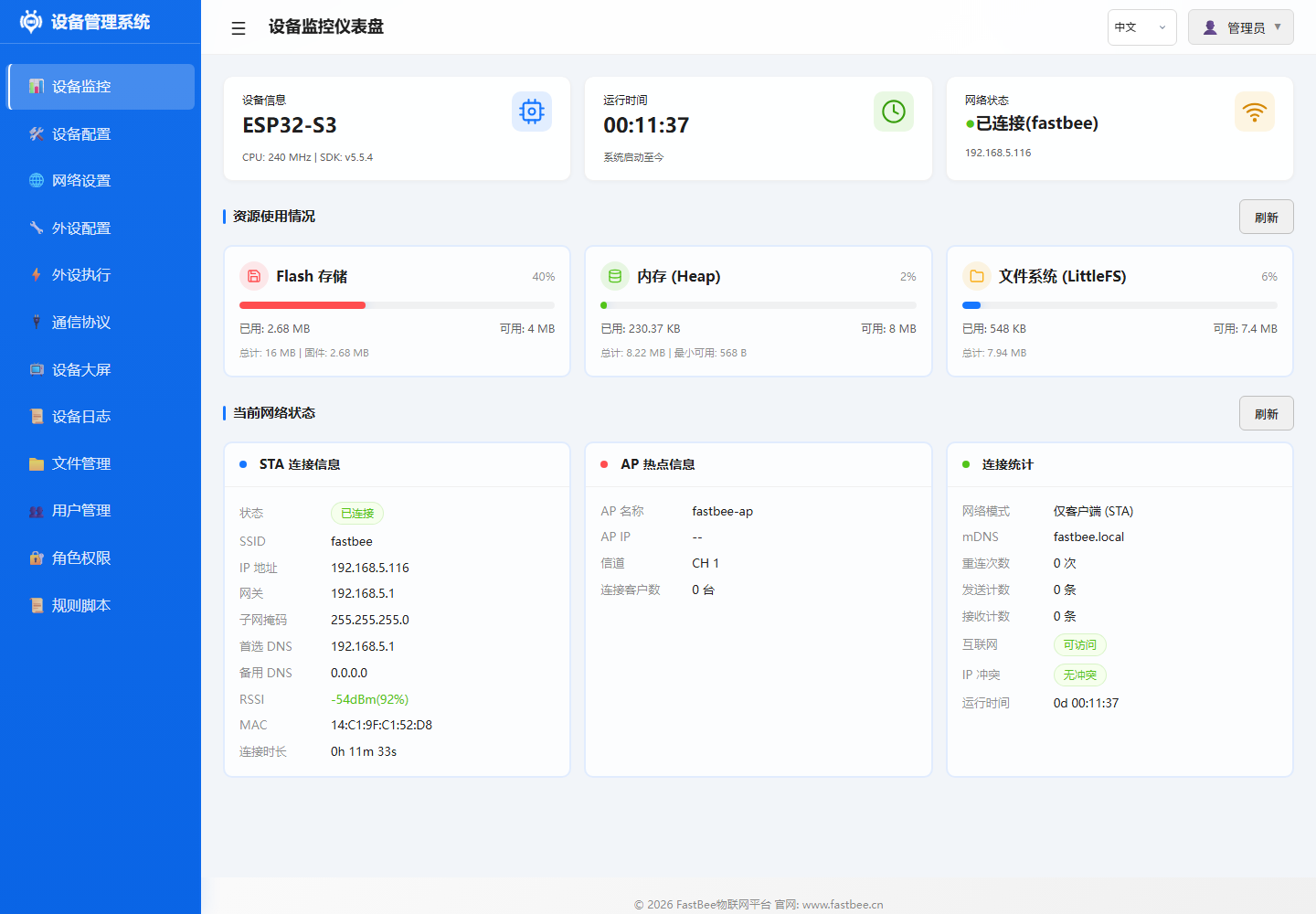
After successful deployment, browse to device IP or http://192.168.4.1, login and confirm IP, WiFi, heap, PSRAM and uptime on the dashboard.
Device Smoke Test
Run the corresponding smoke test immediately after deployment:
powershell -ExecutionPolicy Bypass -File scripts\smoke-test-device.ps1 -BaseUrl http://192.168.4.1 -Profile standard
powershell -ExecutionPolicy Bypass -File scripts\smoke-test-device.ps1 -BaseUrl http://192.168.5.116 -Profile full
When network and MQTT must both be online:
powershell -ExecutionPolicy Bypass -File scripts\smoke-test-device.ps1 -BaseUrl http://192.168.5.116 -Profile full -RequireNetworkConnected -RequireMqttConnectedTest matrix is driven by scripts/device-api-test-matrix.json, covering auth, system info, capability switches, network, MQTT, protocols, peripherals, PeriphExec, batch API, and Full-tier file, log, OTA, RuleScript, user and role interfaces.
Long-term Stability Testing
Before release, run at least 100 soak rounds on delivery hardware. Release thresholds come from scripts/device-stability-thresholds.json:
powershell -ExecutionPolicy Bypass -File scripts\soak-test-device.ps1 -BaseUrl http://192.168.5.116 -Profile full -Rounds 100 -StabilityPreset release -RequireNetworkConnected -ReportPath .pio\test-results\soak-full.csvKey observations: failure rate, P95 response time, consecutive failures, heapFree, heapMaxAlloc, Full edition psramFree, and whether abnormal reboots occur during testing.
Build All Editions
powershell -ExecutionPolicy Bypass -File scripts\build-all-artifacts.ps1 -CleanOutputOutput directory:
dist/business/firmware/all-latest/Release file naming: fastbee-{chip}-F{flash}R{psram}.bin:
| Filename | Environment |
|---|---|
fastbee-esp32-F4R0.bin | esp32-F4R0 |
fastbee-esp32-F8R4.bin | esp32-F8R4 |
fastbee-esp32c3-F4R0.bin | esp32c3-F4R0 |
fastbee-esp32c6-F4R0.bin | esp32c6-F4R0 |
fastbee-esp32s3-F8R0.bin | esp32s3-F8R0 |
fastbee-esp32s3-F8R4.bin | esp32s3-F8R4 |
fastbee-esp32s3-F16R8.bin | esp32s3-F16R8 |
When release packages already exist, field recovery or mass production flashing can write the merged image directly:
powershell -ExecutionPolicy Bypass -File scripts\flash-release.ps1 -Env esp32s3-F16R8 -Port COM6Pre-Release Checks
Local no-hardware checks:
powershell -ExecutionPolicy Bypass -Command ".\scripts\test-all.ps1 -Checks static,native,build,artifacts"After device comes online, add:
powershell -ExecutionPolicy Bypass -Command ".\scripts\test-all.ps1 -Checks device-smoke -BaseUrl http://<device-ip> -DeviceProfile full"
powershell -ExecutionPolicy Bypass -Command ".\scripts\test-all.ps1 -Checks device-soak -BaseUrl http://<device-ip> -DeviceProfile full -StabilityPreset release -SoakRounds 100"
Field Stability Recommendations
- Full edition must use hardware with PSRAM and confirm
psramTotalin/api/system/info?probe=1. - Be cautious enabling OTA, file management, logs, user roles, Ethernet/4G and other high-resource features on 4MB devices; RuleScript is enabled in Standard, but rule count and script length should be controlled.
- Multiple browser tabs and high-frequency refresh increase embedded Web service pressure; when keeping pages open long-term in the field, prefer staying on the dashboard.
- Config import/export should use same-tier or higher-tier devices for organizing before migrating to lower-tier devices.
- Config, peripherals and rules are safely disabled by default; enable item by item after wiring confirmation.